Why Bother Motivating a Child to Help at Home at All?
It’s tempting to just do it yourself – it’s faster, and fights over a messy room feel like more trouble than they’re worth. But the question isn’t really “how do I get this room clean today.” It’s “what is my child learning about themselves by helping – or not helping – around the house.” That distinction is why chores are worth the friction, and it’s backed by more than instinct.
Kids Who Help Early Turn Out More Successful
A University of Minnesota study led by Marty Rossmann followed 84 people from childhood into their mid-20s. The strongest predictor of success in young adulthood – measured by things like finishing education, starting a career, good relationships with family and friends, and staying drug-free – was whether they’d started helping around the house at age three or four. Kids who weren’t introduced to chores until 15 or 16 did worse than those who started at three or four (Rossmann, 2002, University of Minnesota; summarized in Psychology Today).
Rossmann also advises against making chores a deal for pocket money: kids should help because it’s part of family life, not to earn an allowance. The likely reason: chores that are simply part of family life from an early age build an identity – “I’m someone who helps.” Chores introduced later as a one-off ask build a negotiation instead.
So How Do You Actually Motivate Them? Some Parents Just Pay.
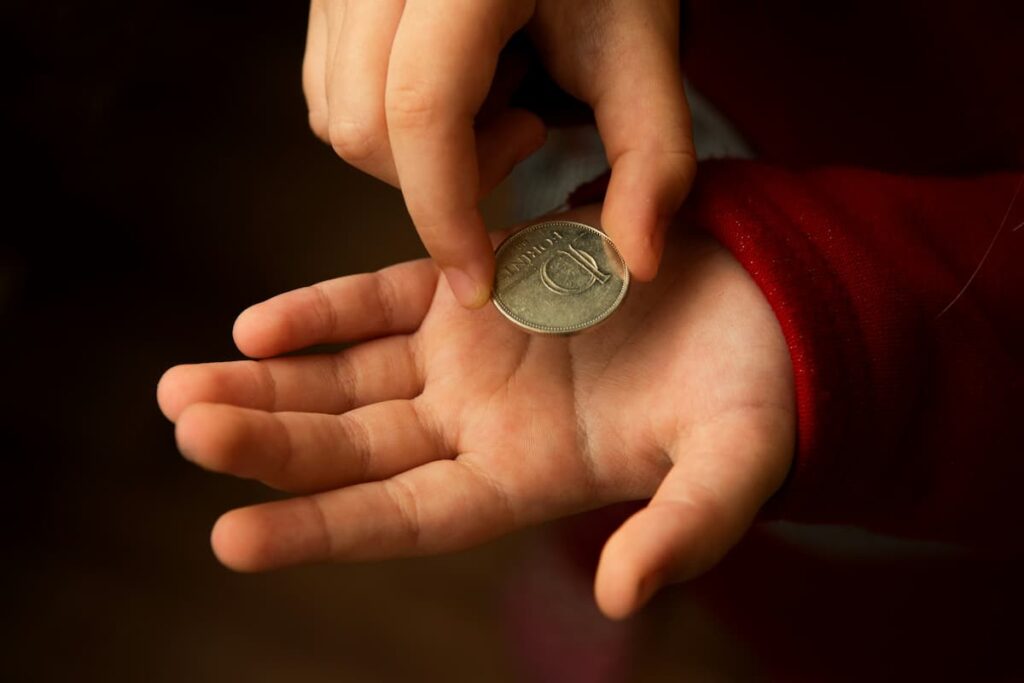
It’s a reasonable instinct. Paying a fixed amount per task is simple, measurable, and it works – today. However, decades of research point to a problem: the moment you attach a specific payment to a specific task, something changes in how a child relates to that task, and it’s rarely for the better.
What the Marker Study Actually Showed
In 1973, psychologists Mark Lepper, David Greene, and Richard Nisbett ran an experiment at Stanford’s Bing Nursery School. They first watched preschoolers through a one-way mirror during free play and identified 51 children (ages 3–4) who already, on their own, enjoyed drawing with colorful markers — no prompting needed.
Those children were then split into three groups:
- Expected Award – told in advance they’d get a “Good Player Award” (a printed certificate with a gold star and a red ribbon) for drawing.
- Unexpected Award – drew with no mention of a reward, then were surprised with the same certificate afterward.
- No Award – drew with nothing promised or given.
One to two weeks later, researchers put the markers back out during free play and secretly timed how long each child chose to draw with them, unprompted. Only the Expected Award group drew noticeably less than before – their interest had measurably dropped. The Unexpected Award and No Award groups kept drawing just as much as ever (Lepper, Greene & Nisbett, 1973).
Psychologists call this the overjustification effect: once a child’s brain re-files an activity as “something I do to get a reward” instead of “something I do because I want to,” the reward becomes the only reason left. Remove it, and the behavior can drop below where it started – which is exactly what a flat “$5 per chore” system risks doing over time.
So Should You Never Reward Anything?
Not quite – the nuance matters here. A 1999 meta-analysis by Edward Deci, Richard Koestner, and Richard Ryan, reviewing 128 separate studies, found that tangible rewards tied to completing or performing a specific task reliably reduced kids’ later motivation to do it unprompted. But rewards that came as informative praise or encouragement – acknowledging competence rather than controlling behavior – had the opposite effect, and actually supported motivation (Deci, Koestner & Ryan, 1999, Psychological Bulletin).
In practice, that means the goal isn’t zero recognition – it’s shifting what gets recognized: not “you emptied the dishwasher, here’s $5,” but noticing and praising the pattern – that they’ve kept up with their morning routine all week, that they picked the chore themselves and stuck with it. The Child Mind Institute and a Psychology Today child psychologist column both point the same way: make chores a shared routine rather than a paid solo job, let kids choose which task, match the task to the child’s age, and praise specifically (“you remembered without me asking”) rather than generically.
This is also where gamification earns its place, if it’s built around the right thing. Points, streaks, and levels tied to showing up consistently – not to a one-time payout per task – mirror the “reward the behavior, not the task” pattern the research actually supports, rather than the pay-per-chore model that backfires.
Sources:
- Rossmann, M. (2002). Involving Children in Household Tasks: Is It Worth the Effort? University of Minnesota. PDF. Summarized in Psychology Today
- Lepper, M.R., Greene, D., & Nisbett, R.E. (1973). Undermining children’s intrinsic interest with extrinsic reward. ResearchGate
- Deci, E.L., Koestner, R., & Ryan, R.M. (1999). A meta-analytic review of experiments examining the effects of extrinsic rewards on intrinsic motivation. Psychological Bulletin, 125(6). ResearchGate
- Child Mind Institute -“How Can I Get My Kids to Do Chores?”
- Psychology Today – “Ask a Child Psychologist: How to Teach Children to Do Chores”
Written with AI assistance, reviewed by our team.
Foto von Andriyko Podilnyk auf Unsplash